Statistical tests

Day 5

Jonas Vollhüter & Felix Nößler

Freie Universität Berlin @ Theoretical Ecology

January 19, 2024

Reproduce slides

1 Introduction to null-hypothesis significance testing

procedure:

  • formulate a null hypothesis (\(H_0\)) and an alternative hypothesis (\(H_1\))
  • collect data
  • calculate the probability of observing data at least as extreme if \(H_0\) was true (p-value)
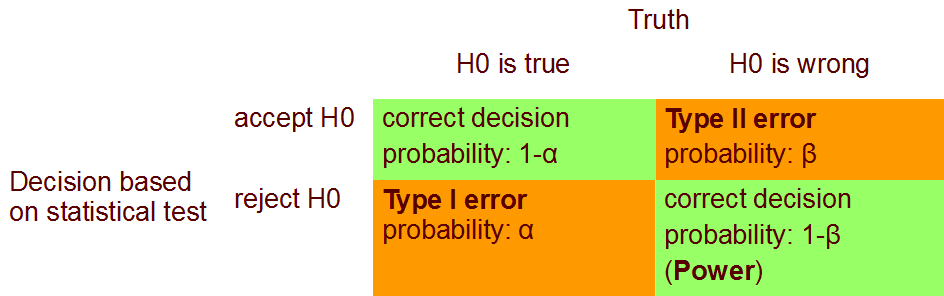
  • if p-value < \(\alpha\): reject \(H_0\) (typically \(\alpha = 0.05\))

2 P-values

  • is used in null-hypothesis significance testing
  • is the probability of obtaining test results at least as extreme as the result actually observed, under the assumption that the null hypothesis is correct

Please note the discussion going on about p-values as a basis for binary decisions. See e.g. here or here as a starting point

Which factors influence the p-value?

  • Variability in the data
  • Effect size
  • Sample size
  • please report all of them in your report/article

3 Simulation study on p-values

Life expectancy

  • simulate life expectancy of 100 people with a log-normal distribution
  • we then compare the life expectancy of two groups (control, treatment) with a Wilcoxon test
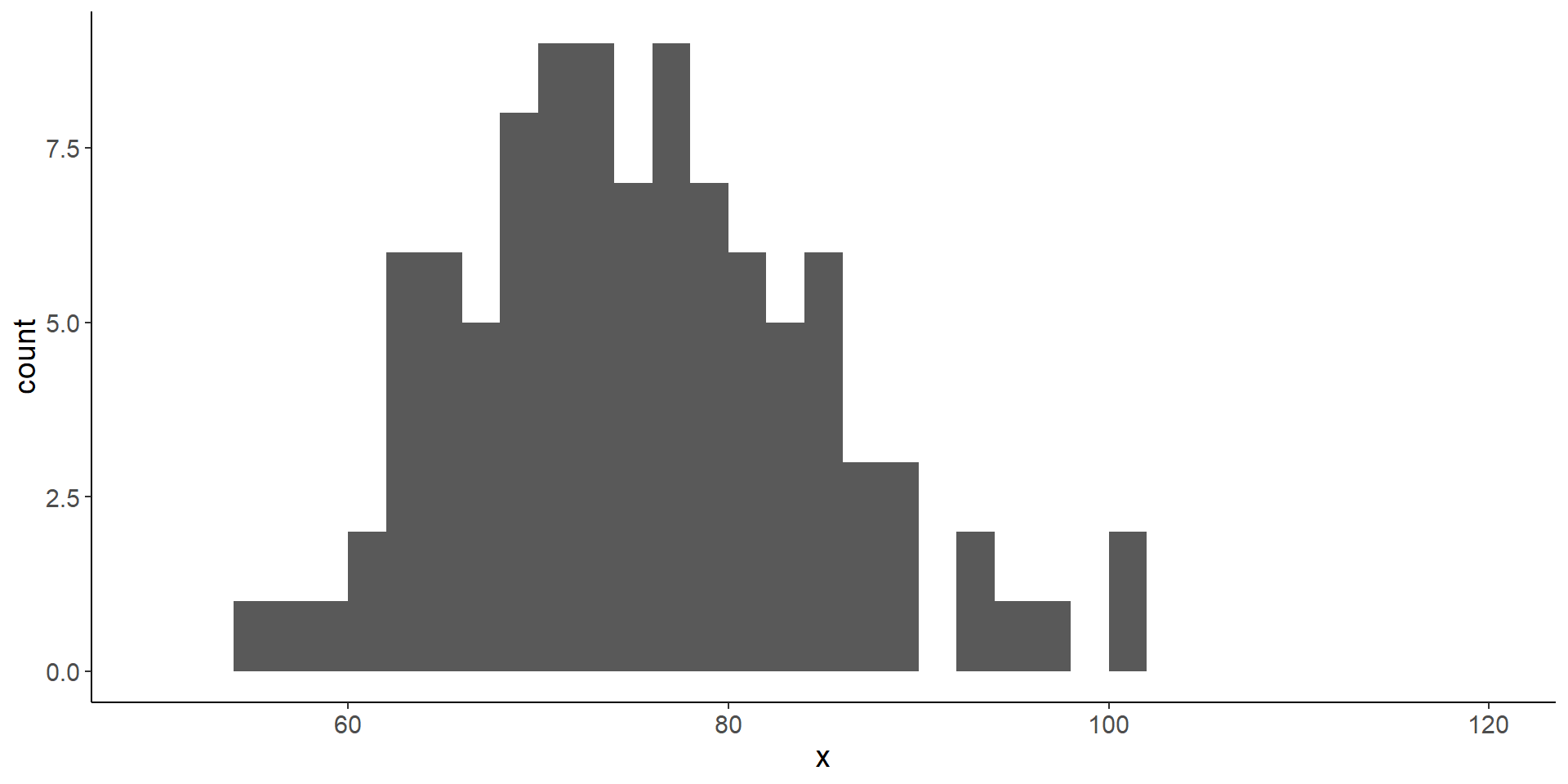
x <- rlnorm(100, meanlog = log(75), sdlog = 0.12)

ggplot() +
  geom_histogram(aes(x), breaks = seq(50, 120, 2)) 

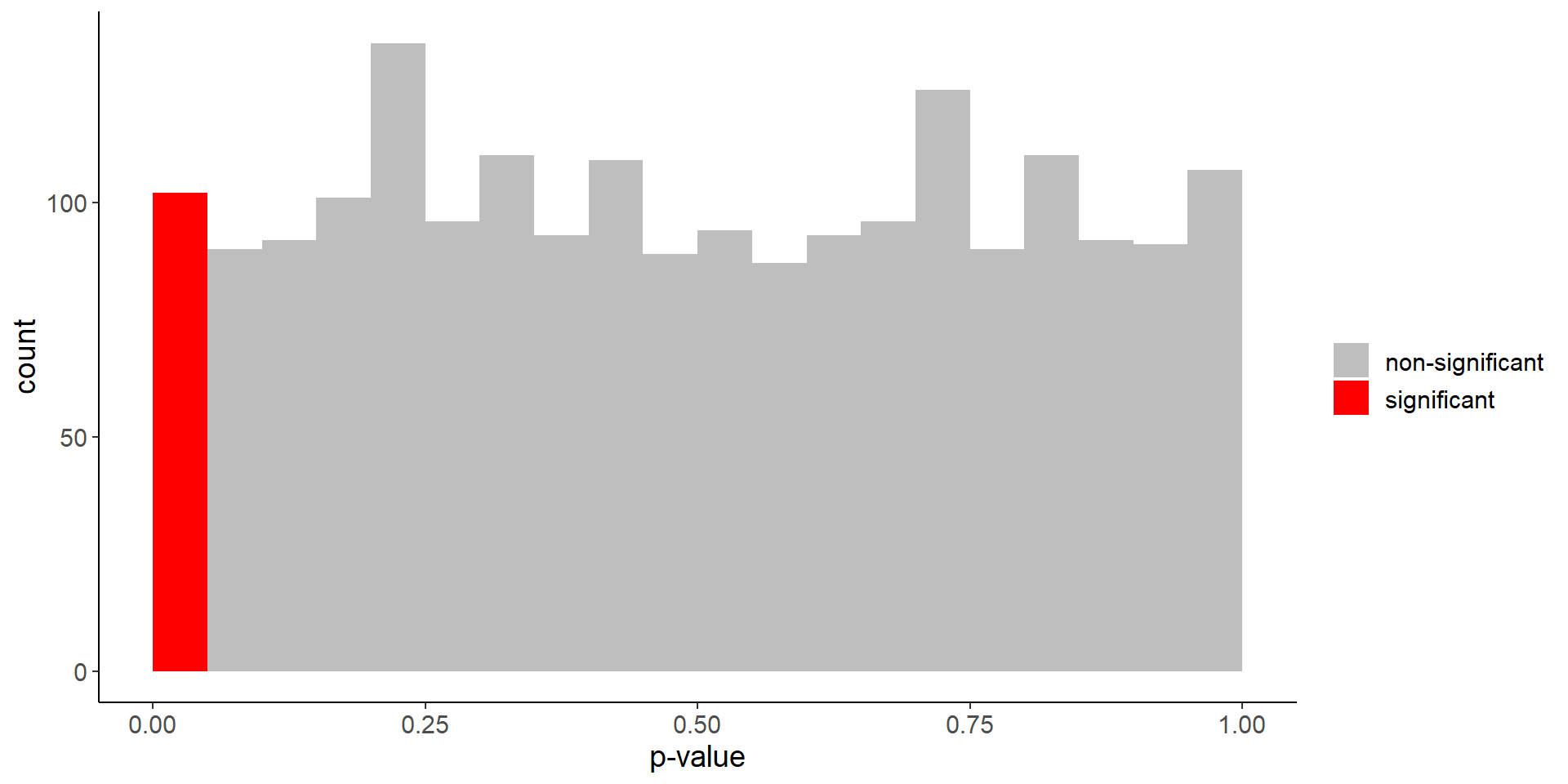
No difference in life expectancy

p_values <- c()
for (i in 1:2000) {
  x_control <- rlnorm(100, meanlog = log(75), sdlog = 0.12)
  x_treatment <- rlnorm(100, meanlog = log(75), sdlog = 0.12)
  p_val <- wilcox.test(x_control, x_treatment)$p.value
  p_values <- c(p_values, p_val)
}

mean(p_values < 0.05)
[1] 0.051
Code
plotting_df <- tibble(p_values = p_values,
                      color = ifelse(p_values < 0.05, "significant", "non-significant"))
ggplot(plotting_df) +
  geom_histogram(aes(p_values, fill = color), bins = 100,
                 breaks = seq(0, 1, 0.05)) +
  scale_fill_manual(values = c("significant" = "red", "non-significant" = "grey")) +
  labs(fill = "", x = "p-value")
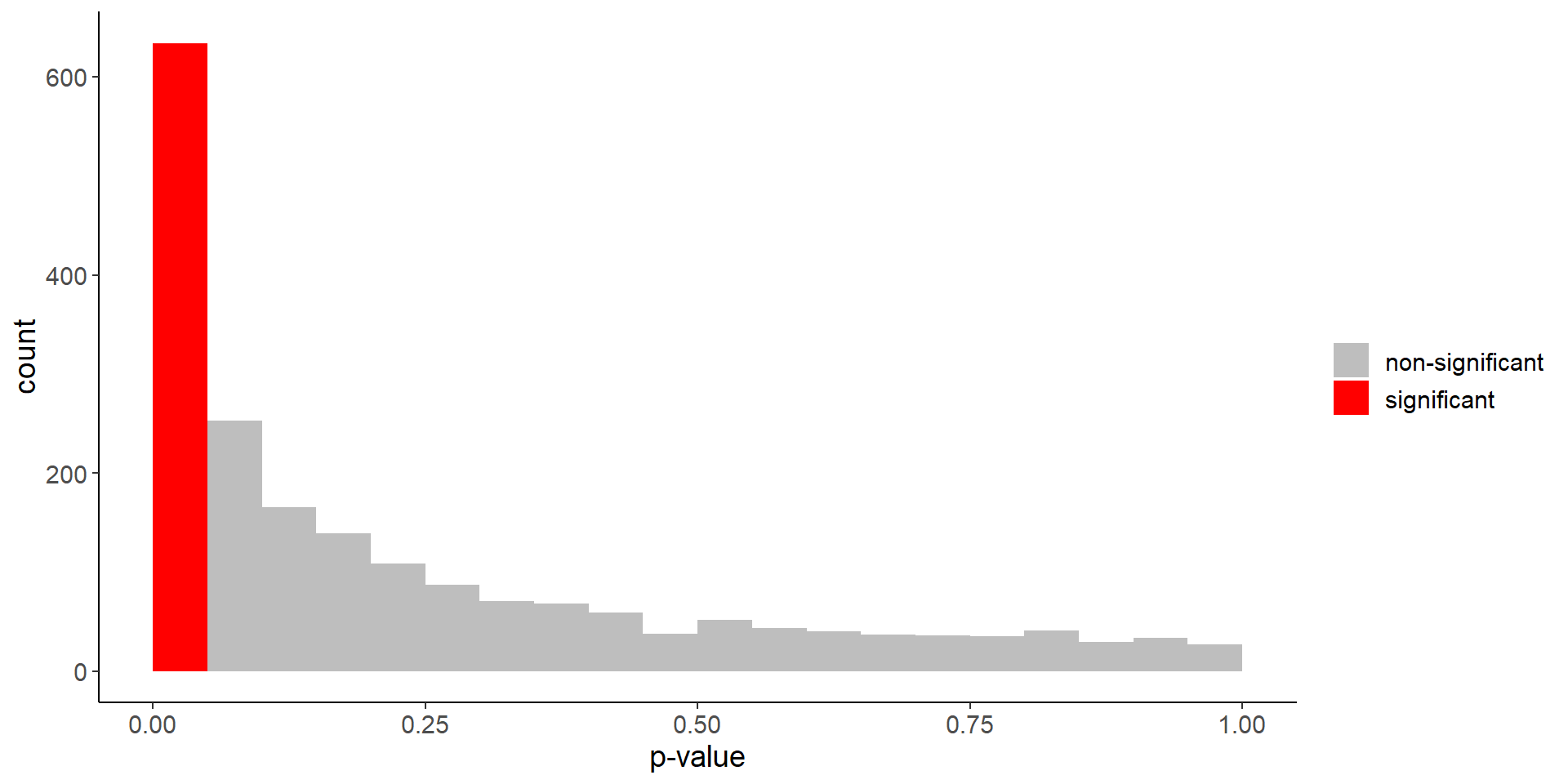
Difference in life expectancy

p_values <- c()
for (i in 1:2000) {
  x_control <- rlnorm(100, meanlog = log(75), sdlog = 0.12)
  x_treatment <- rlnorm(100, meanlog = log(77), sdlog = 0.12)
  p_val <- wilcox.test(x_control, x_treatment)$p.value
  p_values <- c(p_values, p_val)
}

mean(p_values < 0.05)
[1] 0.317
Code
plotting_df <- tibble(p_values = p_values,
                      color = ifelse(p_values < 0.05, "significant", "non-significant"))
ggplot(plotting_df) +
  geom_histogram(aes(p_values, fill = color), bins = 100,
                 breaks = seq(0, 1, 0.05)) +
  scale_fill_manual(values = c("significant" = "red", "non-significant" = "grey")) +
  labs(fill = "", x = "p-value")
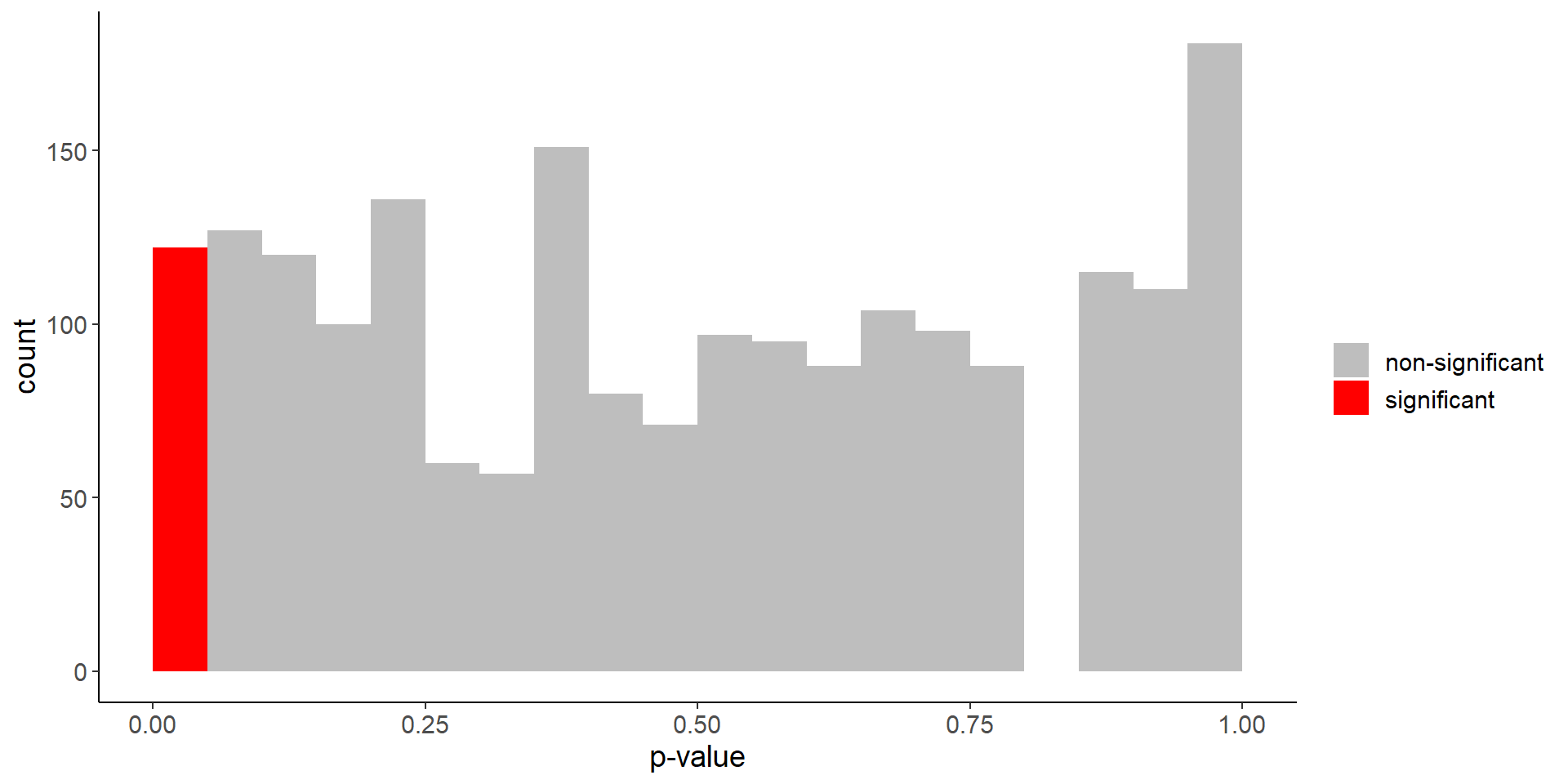
Difference in life expectancy

p_values <- c()
for (i in 1:2000) {
  x_control <- rlnorm(10, meanlog = log(75), sdlog = 0.12)
  x_treatment <- rlnorm(10, meanlog = log(77), sdlog = 0.12)
  p_val <- wilcox.test(x_control, x_treatment)$p.value
  p_values <- c(p_values, p_val)
}

mean(p_values < 0.05)
[1] 0.061
Code
plotting_df <- tibble(p_values = p_values,
                      color = ifelse(p_values < 0.05, "significant", "non-significant"))
ggplot(plotting_df) +
  geom_histogram(aes(p_values, fill = color), bins = 100,
                 breaks = seq(0, 1, 0.05)) +
  scale_fill_manual(values = c("significant" = "red", "non-significant" = "grey")) +
  labs(fill = "", x = "p-value")
Difference in life expectancy

p_values <- c()
for (i in 1:2000) {
  x_control <- rlnorm(100, meanlog = log(75), sdlog = 0.12)
  x_treatment <- rlnorm(100, meanlog = log(80), sdlog = 0.12)
  p_val <- wilcox.test(x_control, x_treatment)$p.value
  p_values <- c(p_values, p_val)
}

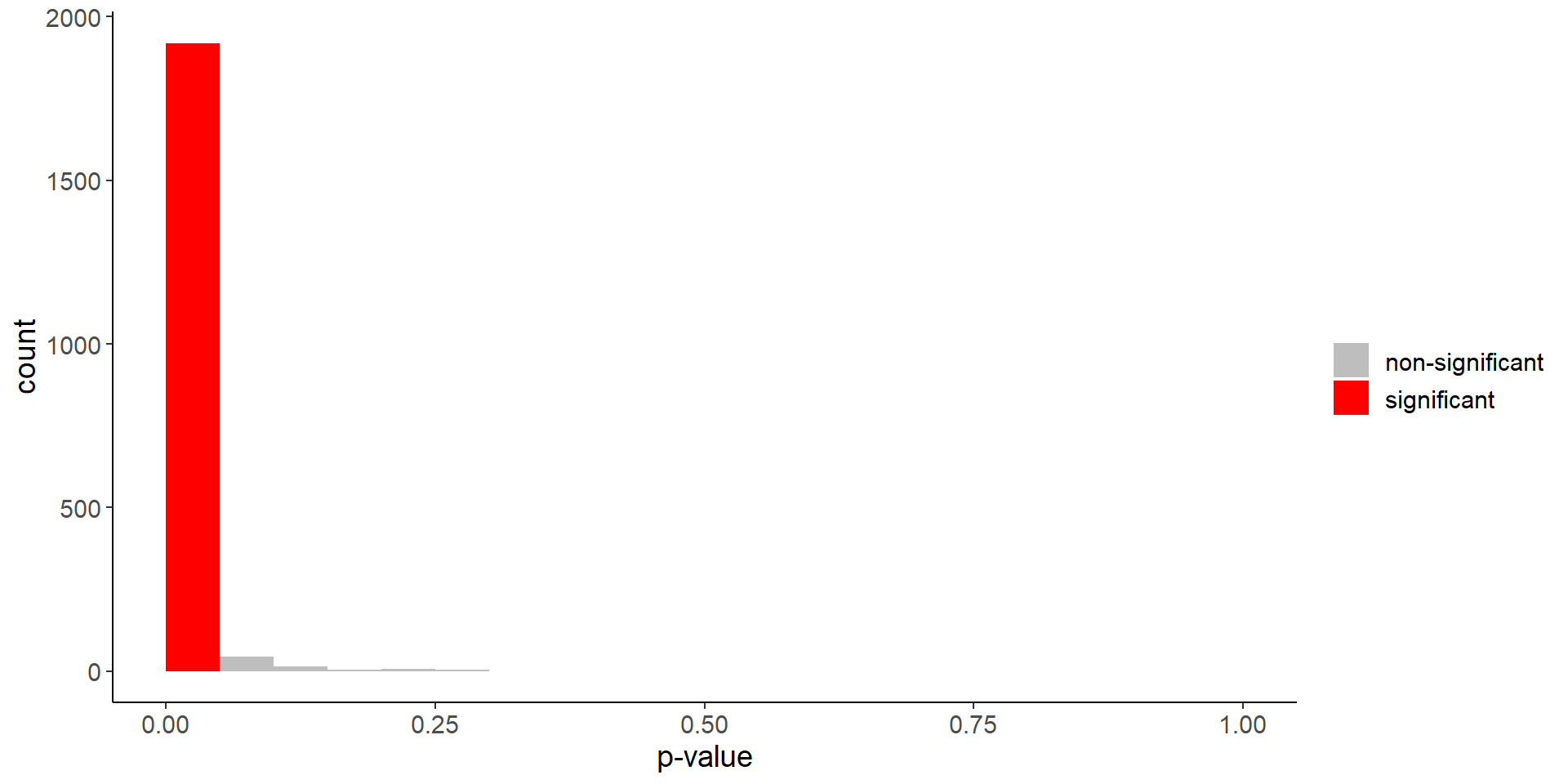
mean(p_values < 0.05)
[1] 0.9595
Code
plotting_df <- tibble(p_values = p_values,
                      color = ifelse(p_values < 0.05, "significant", "non-significant"))
ggplot(plotting_df) +
  geom_histogram(aes(p_values, fill = color), bins = 100,
                 breaks = seq(0, 1, 0.05)) +
  scale_fill_manual(values = c("significant" = "red", "non-significant" = "grey")) +
  labs(fill = "", x = "p-value")
4 Errors in statistical tests
5 Pitfalls - thinks to keep in mind

  • statistical significance does not imply biological significance
  • the null hypothesis is almost never true
  • no statistical significance does not imply no effect
  • arbitrary choice of \(\alpha\) (typically 0.05)

see e.g. here

Please dont’t do:

  • p-hacking: trying out different tests until you find a significant result
  • data dredging: trying out different subsets of your data until you find a significant result
  • multiple testing: doing multiple tests on the same data until you find a significant result (without correcting for multiple testing)

6 Test for equal means (distribution)

t-test

  • Normal distribution AND equal variance
  • Compares if mean values are within range of standard error of each other
  • p: how likely is the difference if the means were equal

Welch-Test

  • Normal distribution but unequal variance
  • Corrected t-test

Wilcoxon rank sum test (Mann–Whitney U test)

  • Non-normal distribution and unequal variance
  • Compares rank sums of the data
  • Non-parametric

Example dataset

InsectSprays: counts of insects in agricultural experimental units treated with different insecticides

TreatA <- filter(
  InsectSprays,
  spray == "A")$count
TreatB <- filter(
  InsectSprays,
  spray == "B")$count
TreatC <- filter(
  InsectSprays,
  spray == "C")$count

t-test

\(H_0\): The samples do not differ in their mean

Treatment A and B: normally distributed and equal variance

t.test(TreatA, TreatB, var.equal = TRUE)

    Two Sample t-test

data:  TreatA and TreatB
t = -0.45352, df = 22, p-value = 0.6546
alternative hypothesis: true difference in means is not equal to 0
95 percent confidence interval:
 -4.643994  2.977327
sample estimates:
mean of x mean of y 
 14.50000  15.33333 
  • t: test statistics (t = 0 means equal means)
  • df: degrees of freedom of t-statistics
  • p-value: how likely is it to observe the data if \(H_0\) was true?

t-test

\(H_0\): The samples do not differ in their mean

Treatment A and B: normally distributed and equal variance

t.test(TreatA, TreatB, var.equal = TRUE)

    Two Sample t-test

data:  TreatA and TreatB
t = -0.45352, df = 22, p-value = 0.6546
alternative hypothesis: true difference in means is not equal to 0
95 percent confidence interval:
 -4.643994  2.977327
sample estimates:
mean of x mean of y 
 14.50000  15.33333 

Result: The means of spray A and B don’t differ significantly (t = -0.45, df = 22, p = 0.66)

Welch-Test

\(H_0\): The samples do not differ in their mean

Treatment A and C: normally distributed and non-equal variance

t.test(TreatA, TreatC, var.equal = FALSE)

    Welch Two Sample t-test

data:  TreatA and TreatC
t = 8.4073, df = 14.739, p-value = 5.278e-07
alternative hypothesis: true difference in means is not equal to 0
95 percent confidence interval:
  9.263901 15.569433
sample estimates:
mean of x mean of y 
14.500000  2.083333 

Result: The means of spray A and C do differ significantly (t = 7.58, df = 13.9, p < 0.001)

Wilcoxon-rank-sum Test (Mann–Whitney U test)

\(H_0\): For randomly selected values X and Y from two populations, the probability of X being greater than Y is equal to the probability of Y being greater than X (if both populations have a similar type of distribution and variance: both medians are equal).

wilcox.test(TreatA, TreatB)

    Wilcoxon rank sum test with continuity correction

data:  TreatA and TreatB
W = 62, p-value = 0.5812
alternative hypothesis: true location shift is not equal to 0

Result: We cannot reject the null hypothesis that the probability of counted insects from treatment A being greater than the counted insects from treatment B is equal to the probability of the counted insects from treatment B being greater than the counted insects from treatment A (W = 62, p = 0.58).

Paired values

Are there pairs of data points?

Example: samples of invertebrates across various rivers before and after sewage plants.

  • For each plant, there is a pair of data points (before and after the plant)
  • Question: Is the change (before-after) significant

Use paired = TRUE in the test.

t.test(TreatA, TreatB, var.equal = TRUE, paired = TRUE)
t.test(TreatA, TreatB, var.equal = FALSE, paired = TRUE)
wilcox.test(TreatA, TreatB, paired = TRUE)

Careful: your treatment vector both have to have the same order

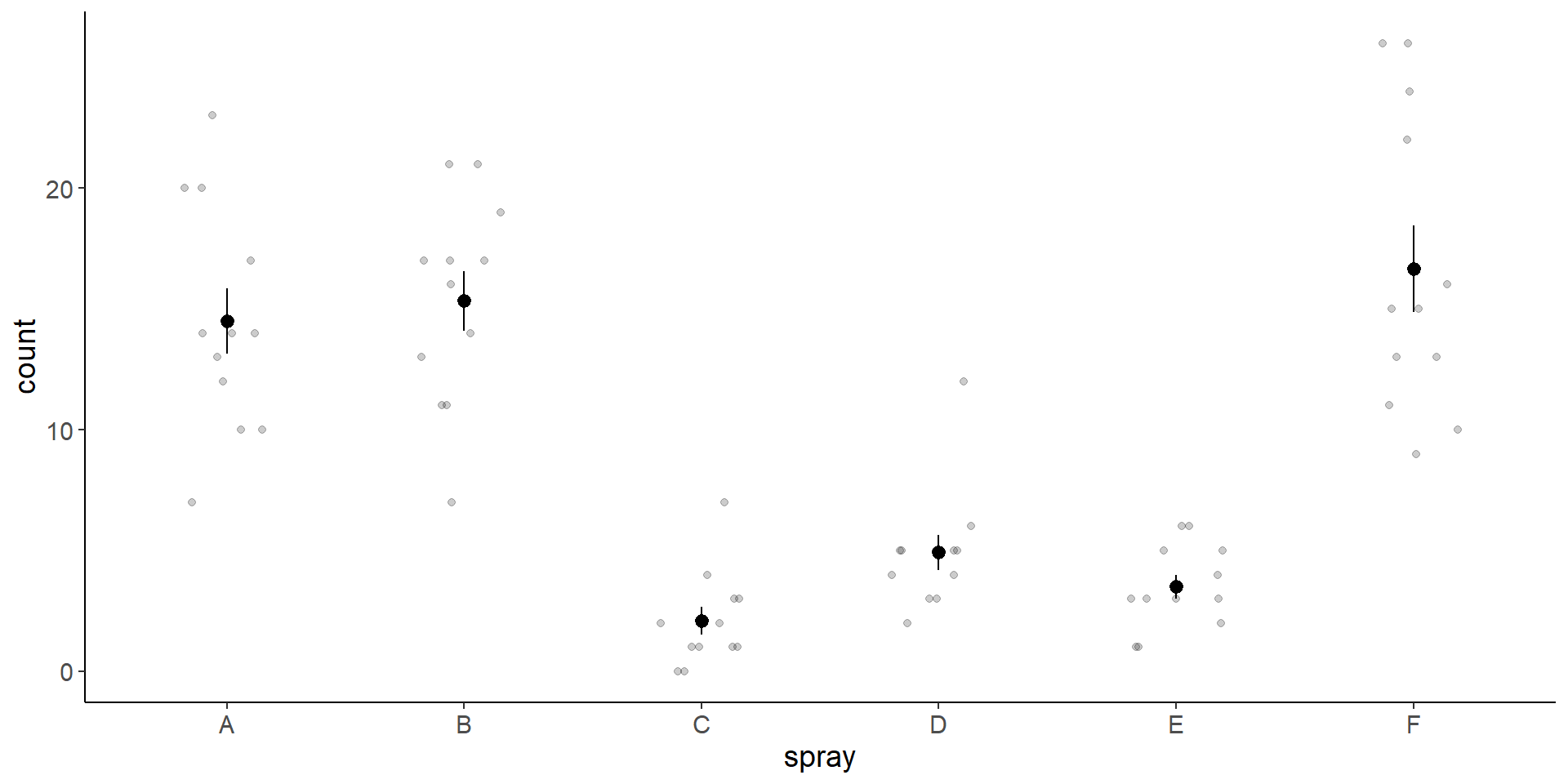
Note: Plot mean +- se using stat_summary

One way to plot the results is to plot mean and standard error of the mean:

ggplot(InsectSprays, aes(x = spray, y = count)) +
  geom_jitter(width = 0.2, height = 0, alpha = 0.2) +
  stat_summary(fun.data = mean_se)