## load packageslibrary(readr)library(dplyr)library(tidyr)library(ggplot2)library(ggfortify)## theme for ggplottheme_set(theme_classic())theme_update(text =element_text(size =14))## read datadf_maples_prep <-read_csv("data/06_maples.csv")## filter out missing values and rename factor levels## and select columnsdf_maples <- df_maples_prep %>%mutate(calcium_addition =factor(watershed, levels =c("Reference", "W1"),labels =c("Control", "Ca addition"))) %>%select(stem_length, elevation, calcium_addition)df_maples
# A tibble: 240 × 3
   stem_length elevation calcium_addition
         <dbl> <chr>     <fct>
 1        86.9 Low       Control
 2       114   Low       Control
 3        83.5 Low       Control
 4        68.1 Low       Control
 5        72.1 Low       Control
 6        77.7 Low       Control
 7        85.5 Low       Control
 8        81.6 Low       Control
 9        92.9 Low       Control
10        59.6 Low       Control
# ℹ 230 more rows
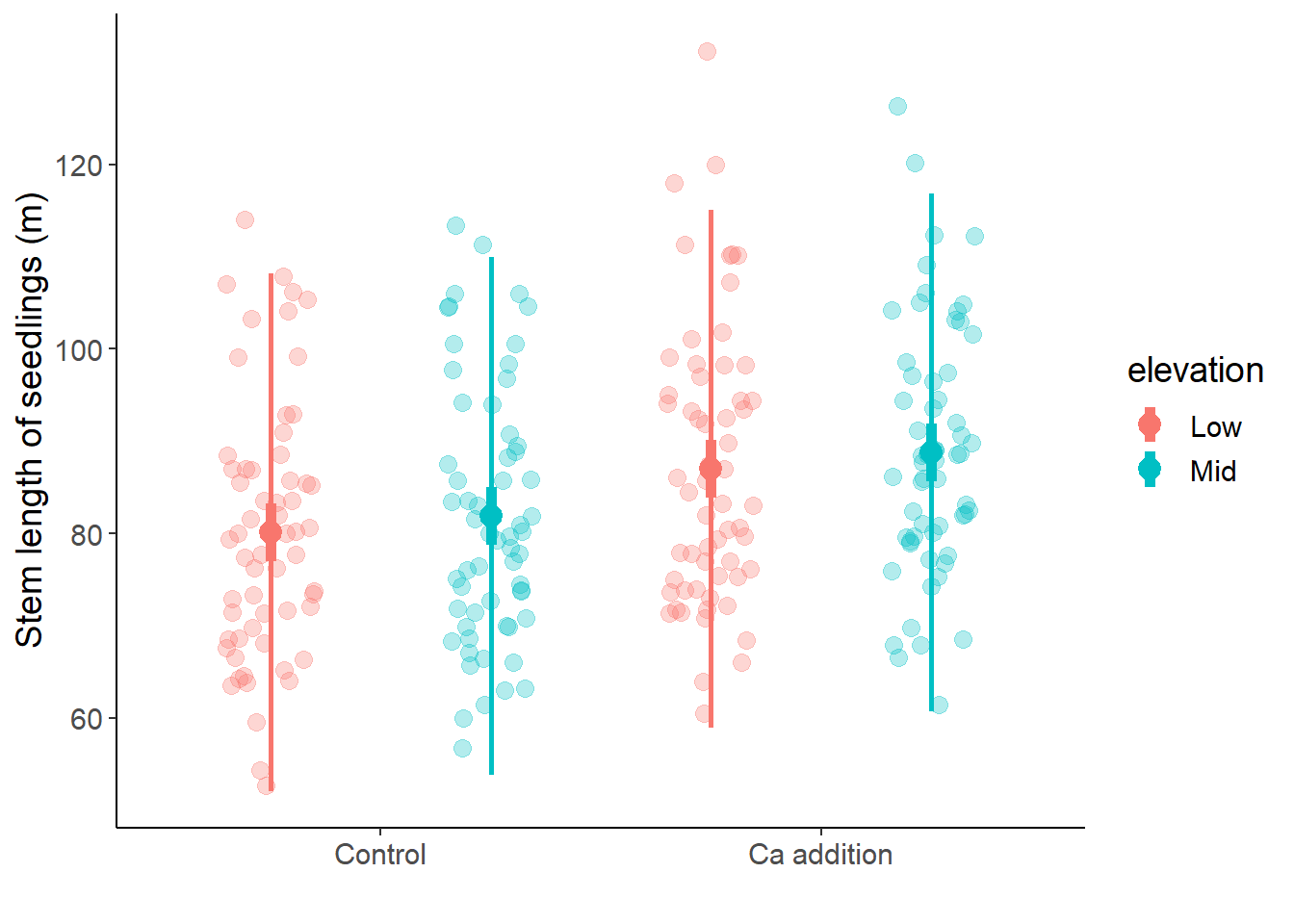
The estimate of the interaction is quite low. The adjusted R² is lower for the second model. Therefore, if you want to make good predictions it is better to use the first model.